They are not air conditioners, and any page telling you one will cool your house is selling you something. But for a specific set of situations, a personal evaporative cooler is genuinely the right tool. Here's how to tell if yours is one of them.
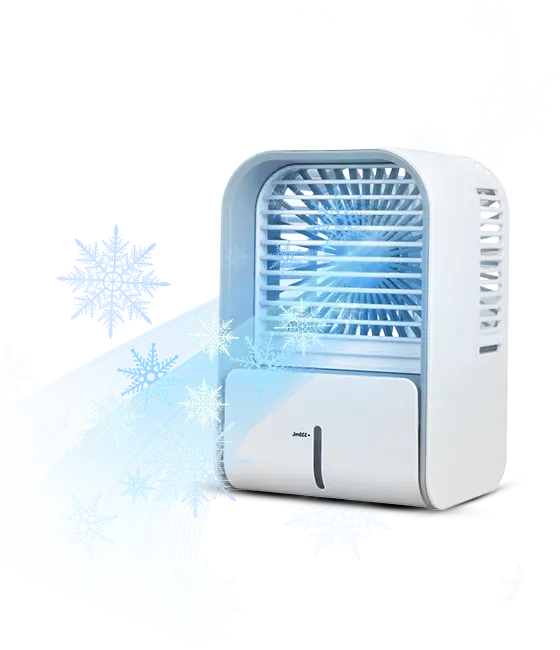
If you have landed here, you probably have a version of the same problem: one room, or one chair, is too hot, and the usual fixes are off the table. Maybe you rent and cannot put a unit in the window. Maybe the thermostat serves the whole floor and you do not control it. Maybe it is a garage, a dorm, a home office over the garage, or a night shift in a building whose HVAC shuts off at six.
Personal evaporative coolers get marketed hard at exactly that frustration, and the marketing is frequently dishonest. So before any product talk, here is the mechanism in plain terms, including what it cannot do.
The physics, without the marketing
An evaporative cooler is a fan that moves air past water — through a wet pad or cartridge, or through a fine mist. As the water evaporates it absorbs heat from the air passing over it, so the air leaving the unit is cooler than the air that went in. That is real. It is the same reason a breeze feels colder on damp skin, and it is the same principle behind the swamp coolers used across the dry American Southwest.
Two consequences follow directly from that mechanism, and they are the two things you need to understand before spending money.
1. It cools the air stream, not the room
A refrigerant air conditioner removes heat from a space and dumps it outside through a hose or an outdoor coil. An evaporative cooler has nowhere to dump heat — there is no exhaust. It moves the same heat around while adding moisture. So it makes the column of air in front of it cooler, and it does not lower the temperature of a closed room. Sitting in the airflow is the entire benefit.
2. Dry air helps it, humid air limits it
Cooling comes from evaporation, and evaporation slows down as air gets more saturated. In Phoenix in July you will feel a strong difference. In Houston or Miami in August, on a muggy day, the difference is modest — and you are adding humidity to a room that already has too much. Climate is the single biggest factor in whether you will be happy with one of these.
The claims to walk away from
This category has a lot of bad actors. If you see any of the following on a product page, treat everything else on that page with extra caution:
- "Replaces your air conditioner" or "cools your whole room in 60 seconds." Physically not possible without an exhaust path. A unit drawing a few watts cannot do the work of one drawing 3,000.
- "Cut your electric bill by 90%." This compares running a desk cooler against running central air — but the cooler cannot replace central air, so the comparison is meaningless. You only save if you were going to leave the air conditioning off anyway.
- Celebrity endorsements and media badges. Famous-name endorsements and "as seen on" news logos are routinely fabricated in this category. Treat any you cannot trace to an actual article or statement as decoration.
- Countdown timers and "only 4 left." Timers often reset when you reload the page, and stock counters are rarely verifiable.
- A precise degree claim with no conditions attached. "Drops the temperature 20°F" is meaningless unless it says at what humidity, measured where, and after how long.
Who these are good for — and who should skip them
Genuinely good for
- Renters and dorm residents who are not permitted to install a window unit, or whose windows do not take one.
- Desk workers in shared or centrally controlled offices, where you cannot touch the thermostat and one corner runs warm.
- Anyone who sleeps hot and wants directed airflow at the bed without cooling — and paying to cool — an entire house overnight.
- Garages, workshops, sheds and hobby spaces with no ductwork, where you are working in one spot.
- Drier climates — the Southwest, the Mountain West, inland California — where evaporative cooling performs at its best.
- People who need something portable that moves between rooms, or onto a patio, without tools.
Skip it if
- You need an actual room brought down several degrees. Buy a window or portable unit with an exhaust hose, or nothing.
- You live somewhere consistently humid and want a dramatic drop. You will be disappointed, and the added moisture will not help.
- You have a medical reason to keep ambient temperature controlled. This is a comfort device, not a medical one. Talk to your doctor about proper cooling.
- You want to run it unattended all day. These have small tanks and need refilling.
What to check before you buy
If you have decided the category fits, these are the specs that actually separate a decent unit from a throwaway one:
| What to check | Why it matters |
|---|---|
| Noise rating in dB | Anything above about 40 dB is intrusive at a desk or bedside. Look for a published figure, not the word "quiet." |
| Tank capacity and runtime | Determines how often you refill. A small tank at high fan speed can empty in a few hours. |
| Power source | Battery units are portable but run for hours, not all night; plug-in units run indefinitely but need an outlet nearby. |
| Ease of cleaning | Standing water accumulates mineral scale and, if neglected, mildew. A tank you can empty and dry easily lasts longer. |
| Power draw | Low-wattage units are genuinely cheap to run. This is worth knowing on its own — not as a comparison against central cooling. |
| Return policy | Because performance depends so heavily on your local humidity, a money-back window is how you de-risk the purchase. |
One unit, measured against the checklist: FrostCooler
FrostCooler is a personal evaporative cooler sold direct to consumers online. It meets some of the checklist above and not all of it, and we would rather show you which parts than call it a perfect fit. It is sold with a return window — which, for this category, matters more than any spec. Our full FrostCooler review goes through it in detail, including what we do not like.
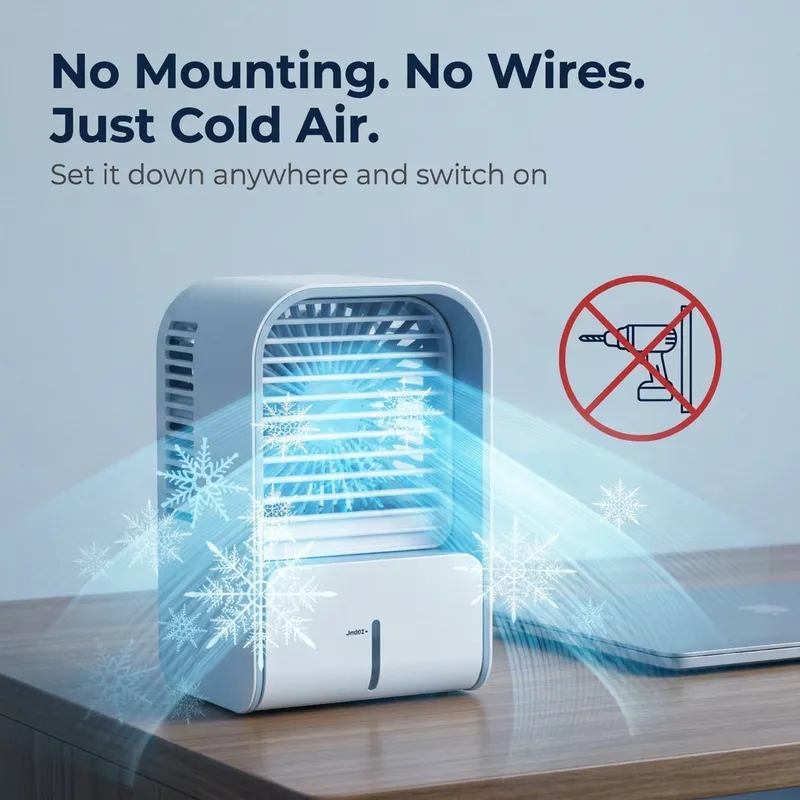
To be explicit about what it is: it is a small, battery-powered evaporative cooler with a water tank and a mist spray. It is not an air conditioner, it has no compressor and no exhaust hose, and it will not lower the temperature of your room. Everything in the sections above applies to it.
Published specifications
| Specification | Details |
|---|---|
| Cooling method | Evaporative + mist |
| Noise rating | Not published |
| Power | 6.5 W |
| Battery | 4000 mAh, USB-C |
| Runtime | 2–6.5 h |
| Water tank | 330 ml |
| Installation | None required |
| Return window | 30 days |
Figures from the seller's official page at the time of writing. The seller describes it as quiet but publishes no decibel figure, so on the first line of our checklist it falls short. We have not independently tested it.
Pricing
The seller advertises promotional pricing with lower per-unit prices on multi-unit bundles. Prices are set by the seller and change often, so check the current figure and the final total at checkout before ordering.
Buy multiple units only if you genuinely have several spots to cool — a second desk, a bedroom, a workshop. Because these units cool the airflow rather than the room, a second one in the same room does very little. The per-unit price is only a saving if you were going to use them.
Opens the seller's official site, where the current price, full specifications and return terms are listed. Sold with a 30-day money-back guarantee; terms are set by the seller and shown at checkout.
Frequently asked questions
Will this cool my bedroom?
No. It will cool the air blowing from it toward you, which can be enough to sleep comfortably if it is pointed at the bed. It will not lower the room's temperature, and any product claiming otherwise without an exhaust hose is misrepresenting how cooling works.
How much does it cost to run?
Very little. A unit in the 5–15 watt range costs a few cents a day at typical US electricity rates — comparable to a small LED lamp. Be sceptical of anyone framing that as savings "versus central air," though: it only becomes a saving if it replaces central cooling, and it cannot.
Does it work in humid climates?
It works, but the effect is smaller. Evaporative cooling depends on water being able to evaporate into the air, and humid air is already close to saturated. In the humid Southeast you will notice airflow and a slight chill; in Arizona you will notice considerably more.
Does it add humidity to the room?
Yes — that is inherent to the mechanism, not a defect. In dry air that is usually pleasant. If you already run a dehumidifier, the two work against each other.
How often does it need refilling and cleaning?
Refill depends on fan speed and tank size; with a small tank, expect to top it up often with regular use. Empty and dry the tank when it will sit unused. Standing water is where mildew starts.
What if it does not work for my situation?
That is what the return window is for, and given how much performance depends on local humidity, we would treat it as an essential part of the purchase rather than a bonus. Keep the packaging and confirm the return process on the seller's site before ordering.
The short version
A personal evaporative cooler is a good answer to "I am hot in this chair and cannot install an air conditioner." It is a bad answer to "I want this room colder." Most of the disappointment in this category comes from people buying it for the second problem because the advertising implied it solved both.
If your situation is the first one — and especially if you are somewhere dry — it is a reasonable, low-cost thing to try, provided you buy it somewhere you can send it back.